Guide
Is This the Personalization at Scale We Were Promised?
Summary of the Article
AI promised every sender one-to-one communication at scale. What most recipients got instead is a recognizable template with a first name swapped in. The reason is structural: when millions of pitches are generated by the same models from the same public profile data, the 'personal' lines converge. The way out is not sharper personalization on the sending side. It is putting the burden of triage back on software, so you do not have to read, judge, and answer every pitch yourself.
- The promise: personalized outreach that reads like a thoughtful human note, sent to everyone.
- The reality: senders using near-identical AI openers, because the systems optimize the sequence, not you.
- The evidence: one large sender-reported dataset found AI-personalized first lines got roughly half the reply rate of a plain template.
- The countermeasure: let an AI screener absorb the pitches, ask your questions, and surface only what qualifies.
For years, the pitch from the AI sales tools industry was simple. Writing a good, researched email used to cost a sales rep 15 minutes. AI could do it in seconds. So every prospect could now get a note that mentions their role, their company's latest news, and a plausible reason for the outreach. Personalization at scale, for everyone.
There is just one problem, and you already know it if you get pitches on LinkedIn or by email: it did not work the way it was sold. What most of us receive is a flood of messages that feel personal one at a time and identical in aggregate.
What Was Promised
The argument made sense on paper. A good cold outreach message works because someone did homework: they looked at what you do, connected it to what they sell, and made a specific offer. AI, the story went, could do that homework at zero marginal cost. Same quality, infinite volume.
Vendors rolled out tools that read a prospect's public profile and company page, then generate an opening line about their latest post or funding round. Every email becomes 'custom.' The dashboards showed personalization happening at scale. What the dashboards did not show is what landed on the other side.
What Recipients Actually Got
Here is the failure mode you have probably seen yourself. Three different senders, three different companies, and each one opens with something like 'I saw your recent post about growing your team' followed by 'worth a quick 15 minutes?' The wording differs slightly. The rhythm is identical.
This happens because every sender's AI runs on the same few language models and reads the same public signals: your LinkedIn profile, your company's funding announcement, your latest post. When a million sellers scrape the same profile data through the same models, their 'personalized' lines converge. Individually fine, collectively obvious.
The scale is part of the problem, not an accident. When a personalized message costs a rep real time, each one carries information: this person chose to spend effort on me. When it costs nothing, that information disappears. A first line like 'I noticed your Series B announcement' used to be a costly signal that someone did research. Now it costs nothing, so it carries no information. As one sender who ran scaled outreach admitted, the volume of 'personalized' cold messages sent to each senior buyer rose by roughly the same factor the cost fell, and buyers adapted by skimming, deleting, spam-marking, and filtering (https://www.getboomerang.ai/post/ai-sdr-backlash).
The Numbers Behind the Disappointment
The clearest evidence comes, unusually, from the sending side. Sales.co, a cold email vendor, built an AI tool that writes a personalized opening line for every contact, believing the standard advice. Then they counted replies across 1,279,153 contacts first-emailed between April 2025 and September 2026. Contacts whose first email opened with an AI-personalized line replied at 0.53%. Contacts who got a plain template with nothing personal in it replied at 1.00%. On replies expressing interest, the gap was wider: 0.15% versus 0.56%, nearly four times (https://sales.co/research/personalization-no-longer-matters).
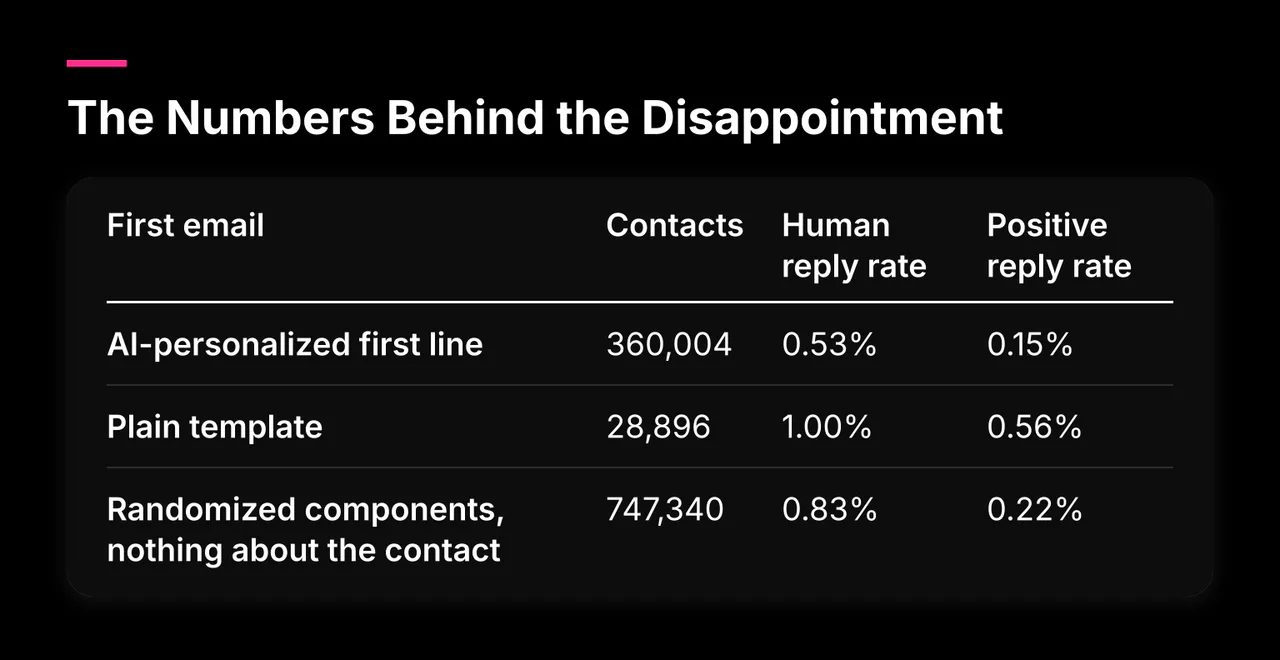
| First email | Contacts | Human reply rate | Positive reply rate |
|---|---|---|---|
| AI-personalized first line | 360,004 | 0.53% | 0.15% |
| Plain template | 28,896 | 1.00% | 0.56% |
| Randomized components, nothing about the contact | 747,340 | 0.83% | 0.22% |
Treat this as directional, not conclusive. It is one vendor's own sending tool and clients, the authors flag their own caveats, such as the personalized class being concentrated in later, lower-performing months, and no one has directly studied how buyers respond when they suspect machine personalization. But it points the same direction as lived experience: the personalized line has stopped being a differentiator because it stopped being rare.
How to Spot Fake Personalization in Your Inbox
You do not need a dataset to protect your calendar. You need a quick triage habit. Ask these questions before giving any pitch your time:
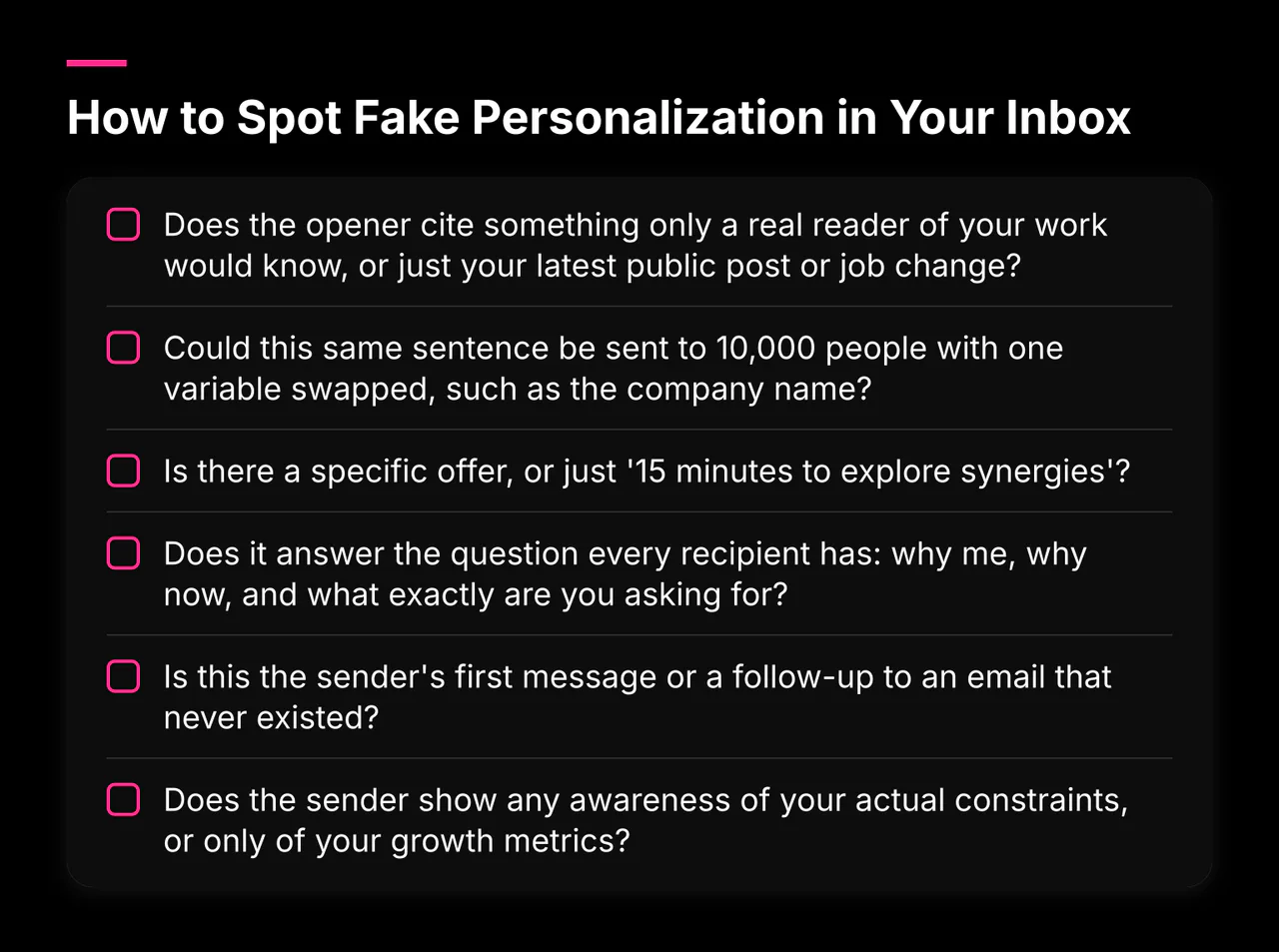
- Does the opener cite something only a real reader of your work would know, or just your latest public post or job change?
- Could this same sentence be sent to 10,000 people with one variable swapped, such as the company name?
- Is there a specific offer, or just '15 minutes to explore synergies'?
- Does it answer the question every recipient has: why me, why now, and what exactly are you asking for?
- Is this the sender's first message or a follow-up to an email that never existed?
- Does the sender show any awareness of your actual constraints, or only of your growth metrics?
If two or more answers are 'no,' you are looking at cosmetic variable substitution. The message signals effort without containing any.
What Real Personalization Would Require
The failure is not personalization itself. It is what passes for personalization. If a sender genuinely wanted to reach you specifically, the message would have to clear a higher bar:
- Distinct data. Something not on a scraped public profile: a problem in your actual workflow, a product you already use, a decision you are publicly weighing.
- A defensible relevance decision. A sentence explaining why you, not just anyone in your job title. 'Anyone with your title' is a segment, not a person.
- A specific offer. A concrete thing that could plausibly matter to you, with a clear ask, not an open-ended meeting request.
- Frequency control. One well-aimed message, not a seven-touch sequence where every follow-up insists you just missed the last one.
- A feedback loop. If you ignore or decline, the sender learns and stops, rather than escalating to the next template variant.
Very little AI sales outreach meets this bar, because meeting it requires an actual judgment about fit, and judgment does not scale by definition. That is the uncomfortable truth under 'personalization at scale': the parts that scale easily are the parts that carry no information.
The Receiver-Side Countermeasure
Here is the part the industry has framed wrong. The response to better fake personalization is not to get better at reading emails faster. It is to stop being the filter yourself.
Notice that the AI pitch flood and the AI screening tool are the same technology pointed in opposite directions. Senders use AI to generate more plausible pitches. You can use AI to evaluate them. Instead of skimming every message yourself, an AI screener can receive your inbound LinkedIn and email pitches, ask the follow-up questions you would have asked based on criteria you define, filter the weak offers, and hand you a summary of the ones that qualified. The sender's automation meets your automation, and you only see the shortlist.
That is the idea behind Let's Not Have a Call, an AI pitch screener built for exactly this: qualifying inbound sales pitches before they reach your calendar. If your inbox problem is part of a bigger pattern, we have written a practical system for reclaiming your time from bad meetings in a pitch-heavy inbox, and an explainer on how AI phone screening works and when you can opt out. More guides live in our guides hub.
What Senders Should Do Differently, Honestly
To be fair to senders, the incentives are brutal. They are measured on pipeline, personalization is cheap to fake, and the recipient's cost never appears in their dashboards. If you send outreach and want to be the exception:
- Personalize the offer, not the opener. A generic email with a relevant, specific ask beats a personalized compliment wrapped around a generic ask.
- Send less. If your reply rate is below 1%, more volume is burning your domain and your brand for little return.
- Make it easy to say no. A clear offer with an obvious decline path respects the reader and, ironically, earns more replies than 'quick question.'
The deeper change, though, is on our side of the inbox. The promise of personalization at scale was that everyone could get a thoughtful note. The reality is that thoughtful notes are rationed by effort, and effort no longer scales. So the rational move is to put a screener between you and the flood, and spend your real attention on the pitches that survive it.
If that sounds better than triaging another 'I saw your post,' you can sign up and create your screener in a few minutes.